Search This Blog

Showing posts with label poetry. Show all posts

Friday, July 15, 2011

MadHat's July Newsletter

Dear Friends:

We’re going sawed off shotguns with our new Blog and getting  impressive submissions to the MadHat Press  poetry chapbook contest,  judged by  CA Conrad.  So please consider submitting to either or both and spreading the word.  And don’t forget to tell every poor cooped up urban dweller about MadHat’s Little Mountain Retreat (& B&B) in gorgeous Asheville, NC.

Former & Forthcoming Review & Blog Contributors & Book Reviewers:

We’re seeking book reviewers to write short reviews  Review and Blog contributors’ new books for our Blog, which means that both putative reviewers and contributors with new books are invited to send requests with details/links to mhrblog@madhatarts.com.  If you already have a reviewer searching for a venue, have her/him send the review to us, bearing in mind the guidelines listed on the blog.  We will also publish a few reviews in our Review issues.   We are not ruling out reviews of art, inventive electronic literature, et al.  Query and we’ll respond.
Contributors are also invited to submit news of book publications and readings/performances.  Please write “NEWS” in the subject line of your email to our blog staff and limit your descriptions to seven lines max.
And:  Contributors are invited to curate MadHat/Review readings/performances/multimedia spectacles/fundraisers in their home towns.  Email askalice@madhatarts.com if you want to host an event.
_______________________________________________________________________________________________

If you haven’t had a chance to peruse our new, inclusive organization’s website, please do.  We’re really excited about our new projects, which include the expansion of the reading series to Asheville, as well as maintaining a presence in NYC.  Our Mad Hatters’ Review Poetry, Prose, and Anything Goes Series will be represented in NYC at 4 pm on July 30th at The First Annual New York Poetry Festival on Governor’s Island.  Our next Asheville reading, once again at The Black Mountain College Museum & Arts Center, will take place on August 18th, and I’ll be flying up to NYC in October for a Mad Hatters’ Review Editors’ Reading at our old haunt, The KGB Bar (October 27th).  All readings and performances will be posted on the blog.

Contributors Jeff Davis (Issue 12) and Lori Horvitz (Issue 13) will join me in hosting a Mad Hatters’ Review radio show this Sunday on Jeff’s Word Play series.  Tune in to Asheville FM 5 – 6pm (EST USA) to hear recitations of works published in the Review.
MadHat Press is embarking on its first full-length publication, a book of poems by our wise and exceptionally prolific friend Hugh Fox.  We hope to have the book out by October.  It will be available for purchase via our Press page, as well as amazon.com, et al.  

The expenses of preparing to open a Retreat have been an enormous strain on the bank account of the Publisher.  There will also be expenses associated with the Press, the non-profit organization, and ongoing expenses to produce the Review.  So once again, I’m asking for contributions, fully deductible for US tax payers.  Your gift of any amount will no doubt yield beneficial Karmic consequences, as well as this Publisher’s heartfelt gratitude.  We need donations to survive!

Wishing you a wonderful, relaxing season without tornados, hurricanes, tsunamis, toxic spills, and nuclear fallout,

Carol Novack, Publisher
askalice madhatarts com

P.S.  If you’re on Facebook, please LIKE MAD ABOUT MADHAT ARTS.


Tuesday, June 14, 2011

Tuesday, February 08, 2011

ISSUE 12 OF MAD HATTERS' REVIEW IS OUT!

February 8, 2011

Dear Friends of Mad Hatters’ Review:

After a very long hiatus, during which The Mad Bunkers’ Mash Issue was emerging slowly, with birthing pains, we are back as an annual and in rarer form than ever with the largest issue since our first baby scream and gurgle in March, 2005. So now we are (nearly) six, way beyond the crawling and drooling stage and quite capable of distinguishing a raven from a writing desk. Well, on second thought . . . but I digress.

Our reading period for Issue 13 will be March 1 – 31. Please see our Submission Guidelines if you want to submit! Just bear in mind that the Hatters aren’t cliquish. If you’re a contributor in 12, you’ll have to wait till 14, et seq.

So on to address Issue 12, aside from the glorious fictions, poems, whatnots, wit & whimsies, non-fictions, the lone drama in homage to Beckett, the texts and vispo’s by our Knock Our Socks Off contest winners, and the mind-bending artworks and music accompanying contributors’ texts. On top of all that, we are thrilled to present two features: “Moving Words,” selected offerings of electronic literature co-edited by Camille Bacos and Jeremy Hight, who will stay on with us as “new media” editors; and “Back From the USSR,” an impressively comprehensive issue in itself, packed with fictions, poems, and artworks by a bevy of crème de la crème contemporary Russians and Ukrainians, mostly in translation. Thanks so! to guest editors Alexander Cigale and Mariya Gusev.

Thanks also to our former art director, Marty Duane Ison, and the poetry editor for this issue, the talented Jefferson Hansen. Welcome poet and visual artist art director Gene Tanta, and Ann Bogle, former contributor and our book review and “creative non-fiction” editor. Ann has a new fiction and non-fiction e-book out. Gene has a new non-virtual poetry book out. Read Gene’s fascinating interview of the eccentric New Zealand-born poet and visual artist Christina Conrad. Paul Gibbons, who created some fine music for this issue, will join Steve Kane, Don Meyer, Suchoon Mo, and Paul Toth in the music department.

We’re acquiring two brand new-to-us incoming editors. Marc Vincenz will join Ann Bogle on “creative non-fiction” and poetry. Born in Hong Kong of Swiss-British descent, Marc has spent much of his life on the road. He lived in Shanghai for 10 years before moving to Iceland where he now works as a freelance journalist and literary critic. His books include Benny & the Scottish Blues, Genetic Fires, and Upholding Half the Sky, which was released by MiPOesias in 2010. Susan Lewis, a contributor of whatnots in this issue, will join Marc Lowe (also the author of a recently published book, as well as a forthcoming one) and Matthew Maxwell as a fiction editor. Why a fiction editor when Susan writes so much poetry? Opines the publisher: that’s the best kind of fiction editor!

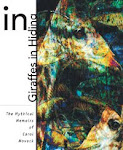
Our columnists for this issue include the infamous and insanely prolific Tom Bradley, who’s published far too many books, and Ann Bogle, who hasn’t published enough of them. We’re pleased to welcome back the former mayor of Ashfield, N.S.W., Australia, poet and gadfly activist Rae Desmond Jones, the astute political commentator, Fatima Shanaz, Professor of political science and President of the India Peace Organization, and the satirical Richard Haber, who stirs up trouble somewhere in the American desert. Poet Jeff Davis, of Asheville, NC, discusses the work of former Black Mountain College resident, poet Charles Olson. And I, Loopdeeloopy Lala, the author of Giraffes in Hiding: The Mythical Memoirs of Carol Novack (Spuyten Duyvil Press, 2010), present a bunch of unanswered love letters and a lawyer’s letter from my collection for (I hope) your amusement.

Expect news of MadHat Press’s first soft cover book: “Knock Our Socks Off: A Little Book of Curious Delights.” Marc Vincenz designed and laid out the collection of winning entries, and the book should be available soon. Also, expect news of our next contest.

Well, that’s the wrap, friends. We hope you enjoy our issue and please do let us know what you think! We’re open 24 hours 10 days a week at madhattersreview at gmail dot com, and we’re always happy to receive comments, suggestions, and donations that are tax-deductible for U.S. residents.


In dementia perpetua,


Carol Novack
Publisher/Editor-in-Chief

Wednesday, July 08, 2009

Drunken Boat | 10 | Spring 2009

Video based on my poem "In the beginning is," created by Orin Buck, music/sound by Paul A. Toth, and recitation by Mad Hatter editors Austin Publicover and Amy Bucciferro. Wondering who's going to find this video, as our photos didn't make the shots of DB contributors on the DB issue homepage and apparently, the video isn't going to be shown at the NYC launch of the "anniversary issue." But... I hope that someone enjoys this collaborative effort!


Drunken Boat | 10 | Spring 2009

Thursday, February 05, 2009

9 Foibles about a Woman from the Left Bank of Limerick

Just out Down Under at The Chimaera with brilliant audio by Austin Publicover:

9 Foibles about a Woman from the Left Bank of Limerick

I.
She lived in a house with a louse of a spouse: a louse, a louse, with lice on his head and a grouse in his bed; no small wonder she wished him dead.


II.
She lived in a house, a mousy gray house and her spouse was a souse: a souse, a souse, with mice in his head and a louse in his bed; no big surprise he wished her dead.


III.
She lived in a house but she wasn’t a mouse; but she looked like a mouse, a plump weeish mouse, and her spouse was a louse, a lard of a louse, as gross as that house; no, he wasn’t a louse, he was verly a mouse, but she was a louse with rice in her head and an old gray blouse; and she killed his pet grouse until it was dead (they said). ...........

(etc.) The Chimaera

Saturday, January 31, 2009

Another Review of the Inaugural Poem

From The New Republic:


Adam Kirsch on Elizabeth Alexander's Bureaucratic Verse

There was inevitably something imperial about the inauguration today: the praetorian pomp, the Capitoline backdrop, the giant crowds, all seemed more redolent of Caesar than George Washington. Even President Obama's speech, for all its predictable poeticizing about America, was not addressed simply to Americans; it was a message urbi et orbi, with sections clearly meant for the ears of Europeans, Africans, and "the Muslim world." (If we were Romans, however, we would have been much more troubled by the bad omen of Chief Justice Roberts and Obama stumbling over the words of the oath of office; for the Romans, a ritual was a ritual, and had to be done right.)

It was oddly heartening, then, to see how completely Elizabeth Alexander's inaugural poem, "Praise Song for the Day," (here's the full text) failed to live up to the standard of public, official verse in which the Romans excelled. When Horace produced his Carmen Saeculare at the command of the Emperor Augustus, as part of the festivities for the Secular Games in 17 B.C., he was happily placing his gifts at the service of the new imperial regime, much as Virgil did when he wrote the Aeneid. So, too, with the Elizabethan poets, who poured their lyrics and masques at the feet of Gloriana. In a monarchy, there is no shame for a poet, or for anyone else, in being the monarch's servant.

In our democratic age, however, poets have always had scruples about exalting leaders in verse. Since the French Revolution, there have been great public poems in English, but almost no great official poems. For modern lyric poets, whose first obligation is to the truth of their own experience, it has only been possible to write well on public themes when the public intersects, or interferes, with that experience--when history usurps privacy. So Wordsworth in 1803, expecting the Grande Armee to land in Kent at any moment, struggled to balance his grievances against England with his fears of France:

England! all nations in this charge agree:

But worse, more ignorant in love and hate,

Far--far more abject, is thine Enemy:

Therefore the wise pray for thee, though the freight

Of thy offences be a heavy weight:

Oh grief that Earth's best hopes rest all with Thee!

Likewise, in 1967, Robert Lowell wrote "Waking Early Sunday Morning" out of indignation at what President Johnson and the Vietnam War were making of America:

Hammering military splendor,


top-heavy Goliath in full armor -


little redemption in the mass


liquidations of their brass,


elephant and phalanx moving


with the times and still improving,


when that kingdom hit the crash:


a million foreskins stacked like trash.

Such poems honor the public by bringing to bear on it the poet's private grief and aspiration. The contemporary poet who set out to write an official occasional poem, on the other hand, gives up the privacy in which modern poetry is born, without gaining the authority and currency that used to be the advantages of the poet laureate in Rome or England. Her verse is not public but bureaucratic--that is to say, spoken by no one and addressed to no one.

"Praise Song for the Day," the poem Elizabeth Alexander read this afternoon, was a perfect specimen of this kind of bureaucratic verse. There was an extraordinary burden of expectation attached to Alexander's poem; I don't recall Maya Angelou or Miller Williams, the poets who read at Bill Clinton's inaugurations, getting the kind of attention that Alexander received in the last few weeks. The reason, I think, is that Obama's inauguration was just the kind of event that might inspire genuine poetry: it was that rare moment when the public intersected with the private for good instead of evil. And of course, Obama himself has often been cast as a "poetic" figure, thanks to his eloquence and the appeal of his image. Last January, E.J. Dionne wrote that Obama represented poetry to Hillary Clinton's prose, a contrast that became a standard trope of the campaign.

Alexander was an inevitable choice to be Obama's laureate. Like Obama, Alexander is an establishment figure-a professor at Yale, a Pulitzer Prize finalist--who is very conscious of the ways she does not fit the usual establishment image--she is a black woman in a field once dominated by white men. Like him, too, she has challenged the establishment by joining it, rather than fighting it. Her best poems--especially in her first, reputation-making book, The Venus Hottentot--do not accept that there is an antagonism between African-American "folk" culture and "high" culture. She has written admiringly about figures like Albert Murray, Ralph Ellison, and Romare Bearden, who fused the two, creating something new and distinctively American. "Ralph Ellison's house is underground/next door to my house," she writes in her most recent book, American Sublime.

Yet Alexander also suffers, as Ellison came to, from excessive self-consciousness about her role as spokesman and example. As she writes in "Ars Poetica #92: Marcus Garvey on Elocution":

To realize I was trained for this,

Expected to speak out, to speak well.

To realize, my family believed

I would have words for others.

But poetry is a matter of having your own words, not of having words for others; and the weakness of Alexander's work is precisely its consciousness of obligation. Her poetic superego leads her to affirm piously, rather than question or challenge. This weakness is precisely what made her a perfect, an all too perfect, choice for inaugural poet. Indeed, in "Ars Poetica #1,002: Rally," published in 2005 when Barack Obama was still just a first-year Senator from Illinois, she already imagines herself lecturing a crowd with inspirational banalities:

I dreamed a pronouncement

about poetry and peace.

"People are violent,"

I said through the megaphone

on the quintessentially

frigid Saturday

to the rabble stretching

all the way up First.

"People do violence

unto each other

and unto the earth

and unto its creatures.

Poetry," I shouted, "Poetry,"

I screamed, "Poetry

changes none of that

by what it says

or how it says, none.

But a poem is a living thing

made by living creatures...

and as life

it is all that can stand

up to violence."

This poem, written for a book and not for an inauguration, is already public in the worst sense--inauthentic, bureaucratic, rhetorical. So it was no surprise to hear Alexander begin her poem today with a cliché ("Each day we go about our business"), before going on to tell the nation "I know there's something better down the road"; and pose the knotty question, "What if the mightiest word is ‘love'?"; and conclude with a classic instance of elegant variation: "on the brink, on the brim, on the cusp." The poem's argument was as hard to remember as its language; it dissolved at once into the circumambient solemnity. Alexander has reminded us of what Angelou's, Williams's, and even Robert Frost's inauguration poems already proved: that the poet's place is not on the platform but in the crowd, that she should speak not for the people but to them.

--Adam Kirsch

Monday, November 17, 2008

Anny Ballardini's Poetic Responses to the American Elections Anthology is growing

While the He/art Pants:

Poetic Responses to the 2008 American Elections


Call for Submissions

Artistic representations, responses, and interrogations of electoral events are very important expressions of the endless conversation between art and historical experience. The 2008 American elections stimulated a lot of artistic responses and there were, in the campaign discourses, some subtle invocations of the postures of presidential aspirants to literature and cultural productions generally. What, as a poet (defined broadly), is the meaning of this whole experience of the 2008 elections? Send us your previously unpublished works (poems, paintings, manipulated photographs, etc) about the 2008 US elections for inclusion in an online anthology:While the He/Art Pants (a title derived from Walt Whitman’s poem reproduced below), to soon appear on the Poet’s Corner, Fiera Lingue. Images should be on Jpeg format. As this promises to be a very interesting project, we request that you send up to five of the most uncompromising and stylistically surprising of your works and a short bio. Other works that do not necessarily focus on the 2008 US elections but are relevant to the dialogue between art and democratic politics will be considered.

Submissions are to be made electronically to: Obododimma Oha (Guest Editor) obodooha@gmail.com , udude@full-moon.com


OR


Anny Ballardini (Editor, The Poet’s Corner)

anny.ballardini@gmail.com

Link to the main index of the site:

http://www.fieralingue.it/modules.php?name=Content


-------------------------------


Election Day, November 1884 from Leaves of Grass by Walt Whitman (1892)


If I should need to name, O Western World, your powerfulest scene and show,
’Twould not be you, Niagara—nor you, ye limitless prairies—nor your huge rifts of canyons, Colorado,
Nor you, Yosemite—nor Yellowstone, with all its spasmic geyserloops ascending to the skies, appearing and disappearing,
Nor Oregon’s white cones—nor Huron’s belt of mighty lakes—nor Mississippi’s stream:
—This seething hemisphere’s humanity, as now, I’d name—the still small voice vibrating—America’s choosing day,
(The heart of it not in the chosen—the act itself the main, the quadrennial choosing,)
The stretch of North and South arous’d-sea-board and inland-Texas to Maine—the Prairie States—Vermont, Virginia, California,
The final ballot-shower from East to West—the paradox and conflict,
The countless snow-flakes falling—(a swordless conflict,
Yet more than all Rome’s wars of old, or modern Napoleon’s:) the peaceful choice of all,
Or good or ill humanity—welcoming the darker odds, the dross:
—Foams and ferments the wine? it serves to purify—while the heart pants, life glows:
These stormy gusts and winds waft precious ships,
Swell’d Washington’s, Jefferson’s, Lincoln’s sails.


Access the expanding list (the roster so far is below) HERE

· Edward Mycue
· Jared Schickling
· Bill Morgan
· John M. Bennett
· Conrad Reeder
· Tom McBride
· Gerald Schwartz
· Farideh Hassanzadeh-Mostafavi
· Russ Golata
· Evelyn Posamentier
· Gina Sangster Hayman
· Matt Johnson
· Susan Bright
· Daniel Zimmerman
· Fan Ogilvie
· Henry Gould
· Carol Novack
· Joseph Duemer
· Peter Ciccariello
· Spencer Selby
· Eugen Galasso
· Grace Cavalieri
· Amy King
· Halvard Johnson
· Raymond Bianchi

indietro

Sunday, November 16, 2008

4th Little Love Story-Poem (Draft 2)

Quantum Physics

Jim and Tim met at The Met. They were scrutinizing a painting of a woman pouting at herself in a mirror as she brushed her exuberant golden hair. Jim looked at Tim and saw Tim as the person he’d always wanted to see in his own mirror, someone who reminded him of himself but substantially more than himself. Tim had the same experience. They looked at one another as though through a magical looking glass and turned instantly into a union: the seeing and the seen, the seen and the seeing. Their tastes were naturally similar, from escargots to crème brulee, Marisot to Klee, and they frequently uttered the same words in unison with glee.

Jim had a wife named Adele, and Tim, a live-in partner named Estelle. Adele and Estelle took back seats to Jim and Tim and had nothing to say to one another, though they frequently rolled their eyes at each other and yawned in empathy. After a while the couple outings lost Estelle, who disappeared, maybe with a man named Marvin she’d met at Tango Tuesdays. Adele, a clinical psychologist, declared Jim guilty of a parasitic form of narcissism that would be his undoing. He returned the diagnosis, with one swift, impulsive stroke, as people are wont to do when they’re rightfully attacked. So Adele left with the child and three cats and Tim moved in with Jim.

Tim and Jim began to grow old together. Eventually with aging came forgetfulness, fuzziness, cataracts and grumpiness. They peered into one another’s mirrors and spat on the glass but their images failed to improve and became cloudier. Teeth turned yellow and dropped out, skin turned the color of ancient bones, and eyes paled. The men threw their mirrors away. But even without the mirrors, Tim reminded Jim of Jim as substantially less than himself and Jim reminded Tim of Tim as substantially less than himself and so they became disgusted and hopeless and decided to unmeet. Tim found a woman named Esme who was more than he’d imagined, and Jim found his son Jimbo a passable portrait painter.

Tuesday, November 11, 2008

3 Little Love Poems/Flashes (Draft)

Any comments, critiques? This will be up for a day or two then gone. I hope you enjoy!

3 Little Love Poems


Relations

Auntie was prone to say: “Cheese is best when sliced thin just like life.” She always bit off a lot of less than she could chew, and avoided more than a mot of mirth, even with dessert and a spot of port. “Take little and relish it, and you will be sufficient. But that’s just my opinion.”

When I was little, I ate too fast and choked at birthday parties. Then I grew up a little and married the first man who’d overcome me, big with an eloquent tongue. I nearly lost my breath till death might do us part.

At Auntie’s funeral, a weeping man hugged me so brutally he caught my breath. He was the man called Happy Henry Auntie had left at the altar. As the attendees gasped, Auntie reversed herself with deliberation and panache, floating down the aisle towards the door. “So sorry, I made a little mistake,” she spoke politely, waving her white-gloved hands.
_______________

His Heart

Carla wore his heart under her sleeve. The heart he’d carved said “Carla and Carl forever,” as if her arm were a tree he’d planted on his property. An arrow with angel wings pierced the dead center of the heart, “a darling, thoughtful touch,” she exclaimed, turning as red as the heart’s aorta. When Carl left for Majorca with Mabel, the wings turned black and blue.

______________

Nostalgia

Short, plump Lili longed for the man on the other side of the square, the one who sat on a bench reading Sonnets to Orpheus. Everything about him was grand and aquiline. Atop the man’s mane of white hair perched a black beret. A black tie always relaxed on his lavender silk shirts; he seemed to have a menagerie of them. Was he always going to a Ball?

The man she called “the one” reminded Lili of what she wished to remember of her childhood: a blueberry sundae with dark chocolate chips. She wondered what color his eyes were. She was an expressionist who loved Kandinsky.

Lili took to wearing a black hat to cover her dull gray hair and a long black silk scarf to adorn her parade of lavender blouses. She started to make a habit of walking by him, winking her hips. Then she added an accessory, a book of poems by Rilke that poked ostentatiously from her mini-tote bag. Lili did this for weeks, months, years, oh what is time? But he never even glanced her way. He was too busy mouthing poems, looked as though he were eating them. Yet he was ever gazing up at the sky, into the sun, with his eyes closed. Lili tried wearing spiked heels to create noises to awaken him from his Rilkean reveries. Nada. Niet. Rien du tout. She tried tripping and ripped her purple stockings on several occasions. Nada. Niet. Rien du tout.

One day, Lili set up an easel in front of the patisserie opposite “the one’s” bench. She brought her most luxurious colors and began to paint him. A crowd soon gathered to exclaim her praises in most colorful words. When the crowd dispersed, “the one” walked cautiously up to the painting and asked Lili if he could suggest a “minor touchup.” “Although I cannot see, I can smell the color you used for my eyes,” he said. "They are in fact absent of color, but perhaps I should say they were, as you’ve made them blush. I can feel you are a warm woman of wit and refinement, the one I’ve awaited to take to the Ball.”

And so they went and that was only the beginning.

Saturday, November 01, 2008

Reading Announcement: MONDAY, NOVEMBER 10TH, Cornelia Street Cafe

6:00 - 8:00 PM POETRY, PROSE, SHORT FICTIONS
29 Cornelia Street, W. Village, NYC (between Bleecker & W. 4th)


C Stone; Carol Novack; Tom Fink; Burt Kimmelman

Carole Stone, Professor Emerita, Montclair State University has published two books of poetry; Lime and Salt, Carriage House Press, 1997 and Traveling with the Dead, Backwaters Press, 2007. Her six chapbooks of poems include Paris Etudes, 2008 and More Sweet, More Salt, 2006, both from Finishing Line Press. A chapbook The Business of Americans was published in the Ezine Beard of Bees in 2008.

Carol Novack writes like a visual artist, instrumentalist, and contortionist. Most of her writings reflect her preoccupation with the abominable events in the present passing history of the Age of Dementia and reveal a perspective of existence as tragic, hysterical, and absurd. Carol publishes the multi-media e-journal Mad Hatters' Review.

Burt Kimmelman has published five collections of poetry � Musaics (Sputyen Duyvil Press, 1992), First Life (Jensen/Daniels Publishing, 2000), The Pond at Cape May Point (Marsh Hawk Press, 2002), a collaboration with the painter Fred Caruso, Somehow (Marsh Hawk Press, 2005), and There Are Words (Dos Madres Press, 2007); his volume of poems titled As If Free is forthcoming in 2009 (from Talisman House, Publishers).

(Tom Fink hasn't provided a bio)

Tuesday, October 28, 2008

Final (for now) version of the poem I was working on

Removing this now, as I've submitted it to journals that might consider this a "publication." If anyone wants to read


A WOMAN BARELY ARMED,

I'll be happy to email it to you.

Tuesday, October 14, 2008

4th Draft of Poem

Draft of a POEM
My friend Anny Ballardini asked me to send her a poem about autumn for her Fierlingue anthology. So here's the poem I've been revising. I hardly ever write poems. This is relatively unflowerly for me.... hope you like it and critique it, if you wish! Miles to go, usually ....


A woman in a white hat


A woman in a white hat was walking toward the end of summer.

A woman barely armed in a white dress walked through the eye of the needle of summer, removed
her white hat
and hummed a floral song.

A goat belched the last moments of summer into the woman’s ears and bleated an udderly ridiculous joke
the woman did not hear. (Animal sense is stronger than ours.)

High on the mountain, looking off as though at a parade of difficult seasons before her, dreaming of soft teal lagoons, the woman wandered
inside herself, selecting warm memories, hot flashes of love.
“I am too insubstantial for Fall and Winter.”

Someone would always appear to contradict the woman. Naturally. She recognized. Clung to herself.

High and hot with bliss at the end of summer,
the woman barely noticed the first breath of autumn.

The voice of forthcoming cool was invisible and susceptible,
a color she could not name.
She returned her white hat to her red head
too thin and the sky was a black shade of blue.
The voice was dangerous.
Well, she saw suddenly there were black dandelions on the roads.

It was an election year.

Someone on a loudspeaker said the summer had come and gone
when the woman was gazing behind her. She saw the man she wanted disappearing
in degrees
descending.

The woman shuddered.
Maybe the voice on the loudspeaker was lying.
She tried to hope.

Noting the crushed flowers on the paths, the woman sensed the end of herself
at the end of the Fall, any Fall,
felt the painful transience of adoration.
Sadness and joy were nothing she could count on: simply Samsara.
Nothing she could count on.
Nothing she could close to off.

The woman tried not to look down on the roads.
She couldn’t help bowing her head hard,
hurried home to their end to prepare for the worst,
to ward off the inevitable, wrap herself in folds of sheep.

The woman tossed her white hat into the sky and found her black hat and cape.
She flew through the mirror of herself, attempting to look carefree
to herself, freed.

I looked through the mirror and found a woman.
Saw her in many hats, many heads floating across the oceans
of my astigmatic vision.

Saw asymmetrical me dissolving inside you
disintegrating, ceasing, reforming, and rejuvenating.

Saw me inside my self dissolving, disintegrating, ceasing, reforming,
and rejuvenating.

Monday, October 13, 2008

Draft of a POEM

My friend Anny Ballardini asked me to send her a poem about autumn for her Fierlingue anthology. So here's what I've managed to write today. I hardly ever write poems. This is relatively unflowerly for me.... hope you like it and critique it, if you wish! Miles to go, usually ....


A woman

A woman in a white hat was walking toward the end of summer.

A woman barely armed in a white dress walked through the eye of the needle of summer, removed her white hat and hummed a floral song.

A goat breathed the last moments of summer into the woman’s ears and bleated an udderly ridiculous joke the woman did not hear. (Animal sense is wiser than ours.)

High on the mountain, looking off as though at a parade of difficult seasons before her, dreaming of soft teal lagoons, the woman wandered inside herself, selecting warm memories, hot flashes of love. “I am too insubstantial for Fall and Winter.”

Someone would always appear to contradict the woman. Naturally. She recognized.

High and hot with bliss at the end of summer, the woman barely noticed the first breath of autumn.

The voice of forthcoming cool was invisible and susceptible, a color she could not name. She returned her white head to her head too thin and the sky was a black shade of blue. The voice was dangerous. Well, she noticed suddenly there were black dandelions on the roads.

It was an election year.

Someone on a loudspeaker said the summer had come and gone
when the woman was gazing behind her. She saw the man she wanted disappear beneath waves of heat. Maybe the voice on the loudspeaker was lying. She tried to hope.

Noting the crushed flowers on the paths, the woman sensed the end of herself at the end of any Fall, felt the painful transience of adoration. Sadness and joy were nothing she could count, or was . . .. Samsara. Nothing she could count on. Or off.

The woman had tried not to look down on the roads. She couldn’t help bowing her head hard and hurried home to the end of the roads “to prepare for the worst, to ward off the inevitable, to wrap her self up in wool.”

The woman tossed her white hat into the sky and found her black hat and cape. She flew through the mirror of herself, attempting to look carefree to herself, freed.

I looked through the mirror and found the woman, saw her in many hats floating across the oceans of my vision. Saw myself dissolving inside you, inside me, disintegrating, ceasing, reforming, and rejuvenating. Saw myself inside myself dissolving, disintegrating, ceasing, reforming, and rejuvenating.


(copyright, yes of course)

Sunday, June 08, 2008

A Poem I like

Mary Jo Bang

H is Here is a Song, Now Sing

The clouds above are speaking
But what they say doesn’t mean much.
So be it. It’s the end
Of a choir and now you’ve divided yourself
From yourself. Now you’re something simple.
You know there’s an answer for everything
But you can’t find one for nothing-to-do.
You wait and you wait.
You learned this from watching the oncoming
Drag behind it one gray burial train.
As in, “One stands alone.”
It’s permanence persisting.
Picture yourself in the now as one on an iceberg,
There since the beginning.
It’s all you know. The sequential
Where consequence follows an action.
Where the ear hears you singing: Nirvana
Over easy. An icicle traces a statement
In the mellowed snow: “It’s a terrible moment.”
The goblet mouth on the table speaks
To your thirst, saying, Longing, your longing, is infinite.

Friday, March 21, 2008

Oxford, Miss., here I come!

PRESS RELEASE

Oxford, MS

VOX PRESS announces an avant-garde literary event on March 28th 2008 to be held at the Power House in Oxford, Mississippi beginning at 5:00 in the evening. The event is part of a documentary project and will be filmed and recorded live on the night of the event featuring some of the nations most experimental literary artists: including Mark Sonnenfeld of East Windsor, New Jersey, Carol Novack of New York City, NY, Joshua Kornreich of New York City, NY, the jazz poet Normal of Saugerties, NY and others. The event/film was also feature local artists as well including Louis E. Bourgeois, Betsy Chapman, Mary Riggs, Clarissa Romano, Zane Gillespie, among others.

The event is open to the public free of charge: donations will be accepted. The audience will play a key role in the documentary itself and audience members are encourage to dress as formally or as outlandishly as they would like: ideally, the audience will appear as interesting as the members of the stage.

The impetus of the event, a part from supporting the contemporary avant-garde literary arts scene, is to call attention and to bring support of VOX Press’s first book publication, Complete With Missing Parts, a collection of interviews with the literary avant-garde of the 21st century which includes literary artists and scholars from around the world and locally as well. The book includes interviews with such scholars and literary artists as Barry Hannah, Charles Wright, Celia Rabinovitch, Ruth Brandon, Russell Edson, Joseph Kronick, Stephen Barber, and many others. The first press run of the book is due out by the early summer of this year.

VOX PRESS is operated by Oxford writer and editor Louis E. Bourgeois and artist J.E. Pitts of the Oxford American. VOX is a pending 501(c)(3) nonprofit organization and is supported in part by the Yoknapatawpha Arts Council as well as the Mississippi Arts Commission.

Saturday, March 08, 2008

March Hare raising readings; April fooleries & frolics


Hi Everyone ----


A bit more info re the March 20th CLWN WR (don't try to pronounce this no matter what you do) reading at the Safe-T Gallery, 7 - 10 pm ( or as late as you're allowed to stay out):

I'll be reading loopy lyricals (whatelseisnewdon'task) with live collaboration by the non pareil beyond postmodern sound and noise artist Austin Publicover (on his noise/sound machine). Atop this post (I hope) is the intricately designed flyer created by the ingenious Bob Heman, Publisher of I bet you can't pronounce it journal (CLWN WR).

If you don't know Austin, proceed to this page at mad hatters'review:

Austin has joined our music department and is assisting in our organization of THE MAD HATTERS' REVUE & LUNATIK BALL at The Bowery Poetry Club on May 4th. He'll also be accompanying Alan Davies's recitation of his wonderful sound/language poems.

Recorded recitations of some of my quirkies will be broadcast on Anne Fiero's "Art Waves' show on Friday, March 14th, from 9-10 PM on WKCR FM NY (89.9 FM and www.wkcr.org). A bunch of the pieces I recited for the show are available, with accompanying sounds and music, on my CD Inventions II: (for a modest song).

In case you happen to be passing through Oxford, Mississippi the Friday eve of March 28th, I'll be somewhere around there at some kind of avantgardey poetry thang.

On April 3rd, I'll be in Buffalo, NY. Write for details if you happen to be in Buffalo.

Then, ok ... lots of miles to the west and south on April 15th and 17th (and afore and aft) for the &NOW Festival at Chapman University, Orange County (http://www.andnowfestival.com/schedule/), right-wing Disney country. And and THEN....

Back in NYC on Sunday, April 20th, I'll be reading in Patricia Eakins's Sunday Best Reading Series, 4pm, at The Lounge, Hudson View Gardens - Pinehurst Avenue and 183rd Street. The other featured readers are Nicholas Johnson and Hattie Gossett. I'll send the official flyer when it's completed. Directions to the Lounge: By subway from downtown: Take the A train to 181st Street. Be at the front of the train. Walk upstairs; take the elevator to Fort Washington Avenue. Cross the little park you'll see (Bennett Park), bearing left around the great circle. When you've crossed the park, you'll be on Pinehurst Avenue. Look left. You'll see 183rd Street, which continues into Hudson View Gardens as a private road. To your right, you'll see a sign that says "The Lounge." )


Have you been getting heartburn from the primaries, no matter whom (if anyone) you're rooting for? Throw your televisions out and check into my two favorite blogs/political websites to find (generally) intelligent commentaries and articles of substance. http://www.markcrispinmiller.blogspot.com/ and http://www.bradblog.com/. You'll get the scoop on everyone, not simply the candidate the blogger's supporting (if any). Of course, you can't believe everything . . ..

Happy Dazelight!

Saturday, February 16, 2008

Reading on March 20th

5th Big CLWN WR Event

Thursday, March 20, 2008
7:00 - 10:00 pm

SAFE-T-GALLERY
Gallery 214
111 Front Street, DUMBO, Brooklyn

FREE ADMISSION!!!


featuring

Carol Novack
Liza Wolsky


with special guests

R. Nemo Hill
Sheila Lanham
Richard Loranger
Mindy Levokove
Jane Ormerod
Adriana Scopino
Moira T. Smith
Joanne Pagano Weber
Nathan Whiting
Francine Witte


hosted by Bob Heman
editor of CLWN WR since 1971


Take the F train to York Street, walk downhill to Front and turn left under the Manhattan Bridge. For more information, maps, and directions from other subway lines please check the Gallery website at http://www.safetgallery.com

Wednesday, February 13, 2008

Writing/publication News

With all the nauseating Obama whoopha & the Clinton misogyny, I think I forgot to post news of a personal nature:

1) My first prosey chapbook, "The Architect's Play," will be published by Poets Wear Prada Press by the end of March or beginning of April.

2) My revamped collaborative CD with more music & audio affects by the exquisitely talented Ben Miller and Don C. Meyer (hear a few tracks at myspace) is available for sale via Mad Hatters' Review
.

3) I'll be featured at a CLWN WR reading in Dumbo on MARCH 20TH (details to be posted).

4) I'll be featured in Buffalo, NY on APRIL 3rd (details to be posted).

5) I'll also be reading at the &NOW Festival (andnow.com) at Chapman University, CA (a bastion of rightwing mentality -- an absolutely appropriate venue for a festival of "innovative" writing), APRIL 15th through 17th (details to be posted).

6) I'll be featured in the gifted writer Patricia Eakins's Sunday afternoon series in Riverdale on APRIL 20TH (details forthcoming).

7) The MHR multi-media BENEFIT on MAY 4TH, 4 - 8pm, at The Bowery Poetry Club will be AMAZING. A list of participants will be posted shortly.

8) The delightful, multi-gifted multi-media writer, Sheila E. Murphy, and I completed our first collaborative project, a streamy, fusionary thang called ROOM. We'll begin our next one soon.

9) I'm not busy waiting for my first rejection of "Violet's Dream."

10) Several writings will most likely appear in Romanian translation in a Romanian print and online journal. Details will be provided sooner or later.

11) I am still having fun with "Gated Communities."

12) I LOVE the latest issue of MAD HATTERS' REVIEW!

Tuesday, January 15, 2008

New arrangement & composition of 5 of my CD tracks

at myspace:

HERE

the page includes the poem/fusion/fablish thing published in Segue with music just composed by one of my brilliant collaborators, Mad Hatters'Review music editor Benjamin Rush Miller, aka Ben Miller. the music and audio are fantastic, as are the others. i hope to offer my revamped CD for sale during the AWP Conference, particularly at the KGB reading on February 1st.

Tuesday, January 01, 2008

New Blog & New Acceptance for the New Year

I've given birth to a new blog this first day of January: The Sex Lives of Starfish & Other Tales. Please drop by to read the epistolary tales in progress.

A wonderful opening for the new year was an acceptance which arrived in email form. "Four Variations" will be published in February or March in the British Literary Journal, Tears in the Fence. I submitted it as a fiction, but the publisher, David Caddy, calls the quartet a poem.